After Print & Play Closed: Where Should Board Game Designers Make Prototypes?
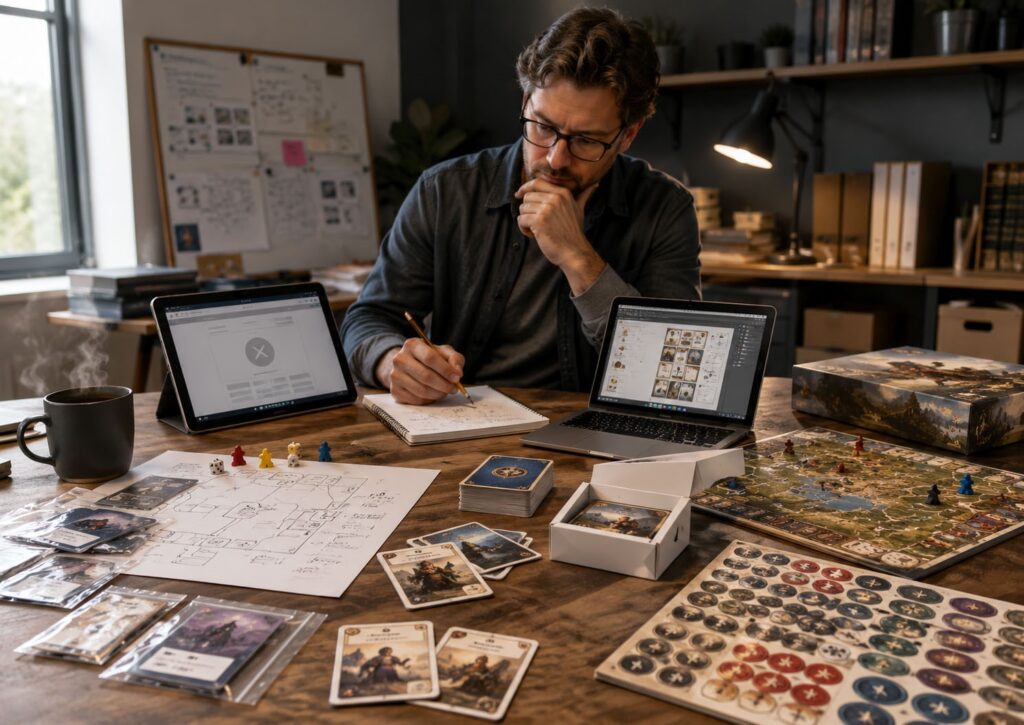
When Print & Play closed in 2026, many board game designers started asking the same question:
“Where can I find another service that prints prototypes the same way?”
The points in the wrong direction although the question is understandable.
A board game prototype service is not one fixed thing. A home print-and-play file, an online POD prototype, a factory digital sample, a pre-production sample, and a 100-set Kickstarter preview copy are not different prices for the same job. They belong to different stages of the product.
The real question is not:
“Who replaces Print & Play?”
The better question is:
What kind of prototype are you trying to prove?
If you choose the wrong prototype route, the mistake usually appears later. Sometimes it appears as wasted budget. Sometimes it appears as a sample that looks good but cannot be manufactured at the same cost. Sometimes it appears as a 100-set “prototype run” that is priced like a small production batch, because from a factory point of view, that is what it actually is.
This article is written from a board game manufacturing point of view, not from a one-click upload platform point of view. The goal is to help you stop buying the wrong sample for the wrong stage.
This article is part of our 2026 series: Board Game Prototyping Problems Creators Face in 2026.
The series looks at the problems many independent creators meet before mass production: lost prototype options, overcomplicated designs before the first paid prototype, small-batch pricing, printing defects, dark artwork risks, and AI-generated files that still need factory cleanup before they can be produced.
Print & Play Closed, But the Real Problem Is Prototype Purpose
Print & Play was useful because it sat in a rare middle space.
It was not only a home printer.
It was not a full board game mass production factory either.
For many designers, it was a practical place to print custom cards, small prototype quantities, promos, early demo copies, and odd test parts without immediately entering the full factory workflow.
That middle space matters because most creators do not move cleanly from “I have a game idea” to “I am ready for 1,000 copies.” There are messy stages in between: rule testing, blind playtesting, publisher pitching, convention demos, Kickstarter photography, reviewer copies, and final production approval.
All of these are often called “prototypes.”
From a factory side, they are not the same.
A rule-testing prototype can be ugly.
A publisher pitch copy should be clean, but it does not need to follow every mass-production structure.
A Kickstarter preview copy needs to look close to the final product.
A pre-production sample needs to check the real production method.
A 100-set batch is no longer just a prototype if those copies are being sold, photographed, reviewed, or sent to backers.
This is why looking for a perfect board game POD alternative can become a trap. The replacement is not always another POD service. Sometimes the correct answer is home PNP. Sometimes it is a factory digital sample. Sometimes it is a small production batch. Sometimes the honest answer is: “You are not ready to pay for this stage yet.”
That last answer sounds harsh, but it saves money.
Do Not Search for a Supplier Before You Lock the Prototype Stage
The usual mistake is searching for suppliers before locking the prototype purpose.
Designers often ask:
“Can you make a prototype?”
A manufacturer has to ask back:
“What must this prototype prove?”
That is not a delay tactic. It changes the production route.
The decision sequence should be:
Cost control generally fails at step 1, not step 5.
If the game system is still moving, a beautiful factory sample becomes expensive scrap very quickly. Change 20 cards, increase the board size, add one punchboard, or switch from a tuck box to a rigid box, and the previous prototype no longer represents the product.
From a manufacturing perspective, that is not “normal iteration.” That is budget leak.
The first rule is simple:
Do not buy a production-looking sample while the product is still moving.
If your rules, card count, token types, or upkeep steps are still changing, the next step is not finding a better prototype supplier. It is cutting the design down before you pay for a printed sample. We explain that process in Before You Print a Prototype: How to Cut Rules, Components, and Cost From Your Board Game.
There are exceptions. A convention demo or publisher pitch may need to look presentable before every detail is final. But even then, you should avoid locking expensive structure too early. Clean cards are useful. A custom insert, heavy mounted board, specialty box, and sculpted pieces may be premature.
A prototype should answer the next manufacturing question, not flatter the current design file.
When Home PNP or POD Is Still the Better Choice
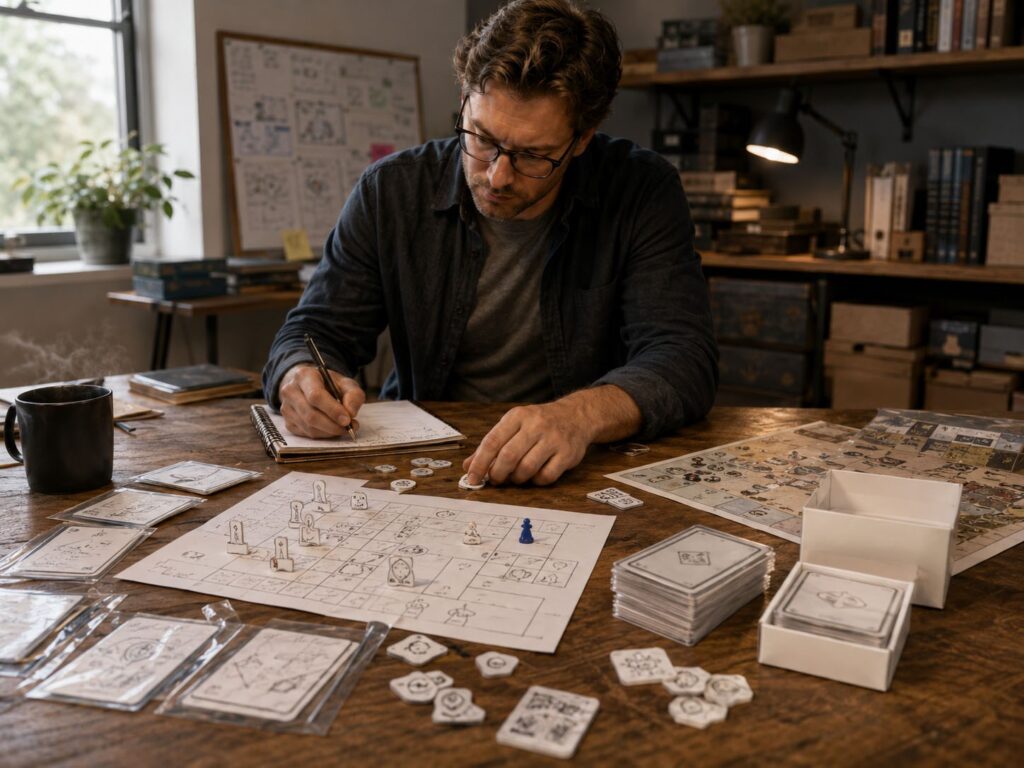
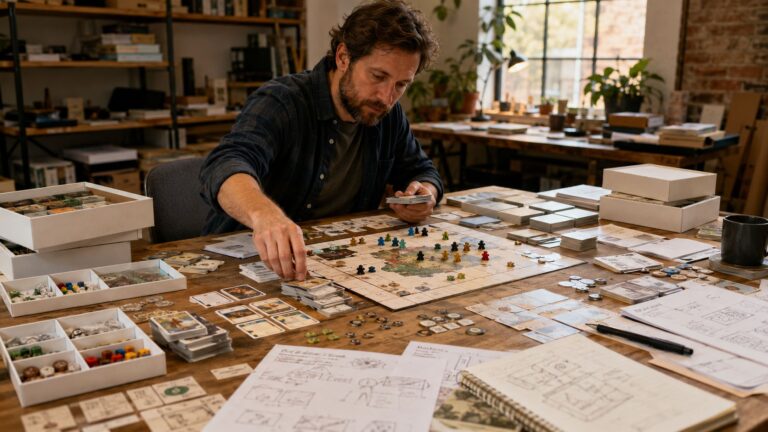
Home PNP is not glamorous, but it is still the correct choice when the rules are changing.
If card text changes every week, if the board layout is unstable, if player count is still being tested, or if the token system may change, do not rush into factory samples. Use paper cards, sleeved cards, simple printed boards, sticker sheets, or rough tokens.
At this stage, the prototype is not supposed to prove print quality.
It is supposed to prove whether the game works.
A rough home print-and-play prototype that gets played twenty times is more valuable than a polished sample of a game that still needs structural changes.
POD prototype services sit one step above that. They work well when the game fits the available templates: standard card sizes, simple decks, basic tiles, simple boards, and a few clean demo copies. For designers searching “print board game prototype online,” POD can still be useful when the goal is speed and presentation, not final manufacturing proof.
The key phrase is: when the game fits the platform.
POD feels flexible because you can upload files and order a small quantity. But it is flexible inside a controlled menu. Once your game depends on unusual card sizes, thick mounted boards, shaped punchboards, rigid boxes, custom inserts, wooden meeples, plastic parts, or exact retail packaging, POD starts to lose accuracy as a production reference.
That does not make POD bad.
It means POD is not a factory rehearsal.
Use home PNP when the game is still changing.
Use POD when you need a cleaner early prototype and your components fit the platform’s standard options.
Do not use either one to approve final card stock, final box structure, punchboard release, carton efficiency, or mass production cost. They were not built to answer those questions.
When a Factory Sample Starts to Make Sense
A factory sample starts to make sense when the prototype needs to check real product structure, not only game rules.
This is different from a POD prototype. A POD copy may be useful for showing the game, but it often uses the platform’s own material, size, finish, and packaging limits. A factory sample is used when you need to see how your game behaves closer to the intended manufacturing setup.
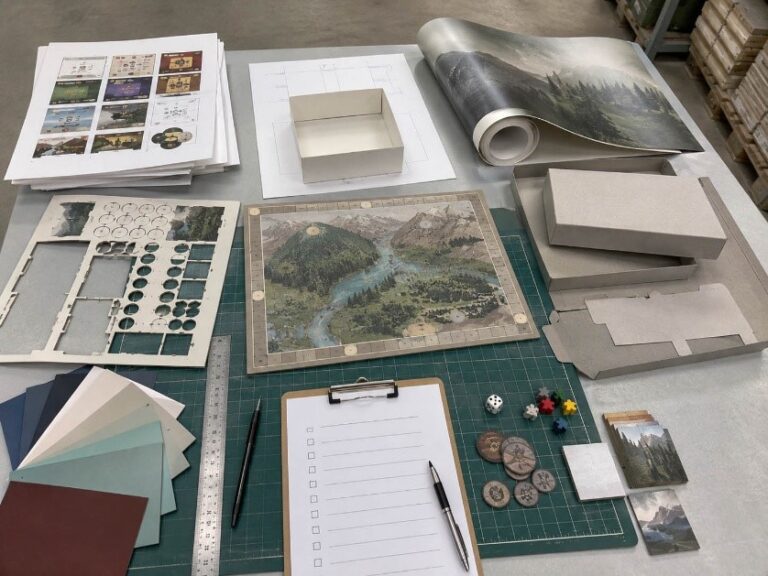
For most custom board game prototypes, the first factory sample does not need to run on the full offset printing line. That would be too expensive for one complete board game sample, especially when the game includes many printed parts: cards, game board, punchboards, box, rulebook, and inserts.
A more practical route is usually high-resolution digital printing with production-intent materials and real product dimensions.
That means the sample can still use the planned material direction. If the final cards need black core paper, the sample can be made on black core paper. If the board needs mounted greyboard, the sample can use mounted greyboard. If the box needs matte lamination, the sample can be finished with matte lamination. The printing method is different, but the structure is not only a paper mockup.
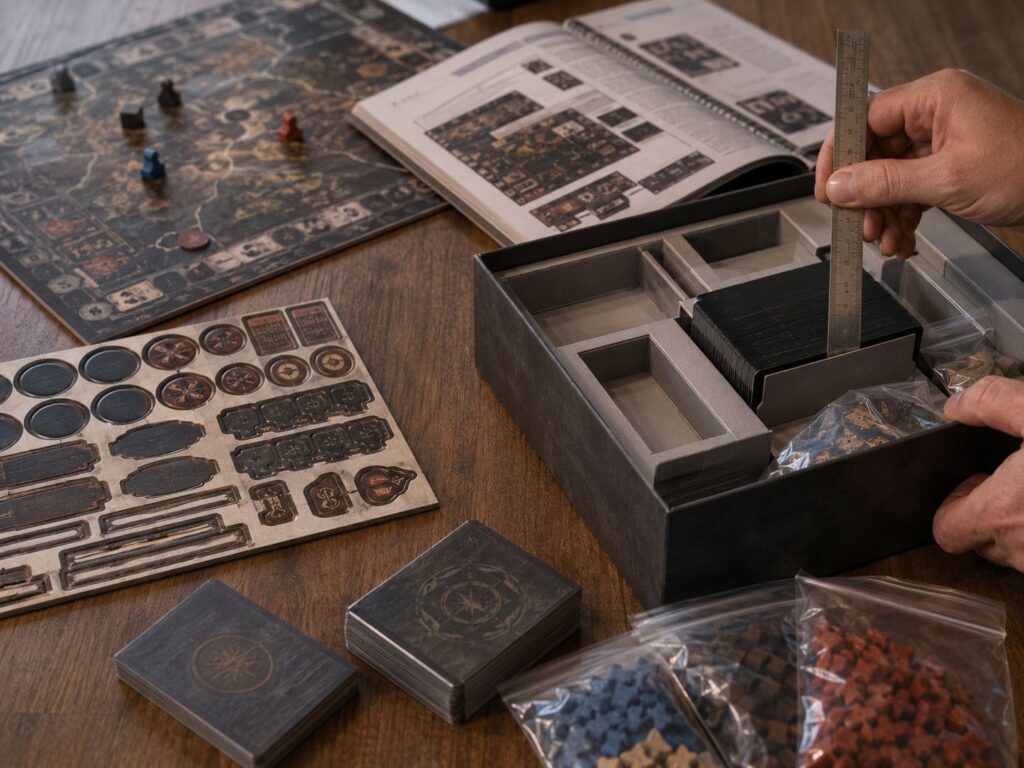
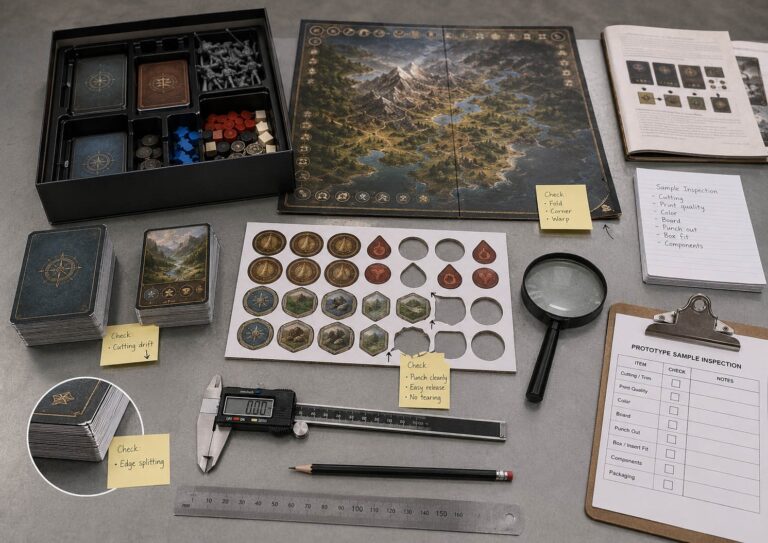
This kind of factory sample is useful for checking the things that usually cause trouble later:
These are not small details. A 1.5 mm punchboard and a 2.0 mm punchboard do not behave the same inside a box. A board fold direction can change the box footprint. A rulebook that is only a little thicker can push the lid higher. A blister tray that looks good in a render may still make the cards hard to remove.
This is why a factory sample is often more useful than another online prototype once the component list starts to become real.
But it still has a boundary.
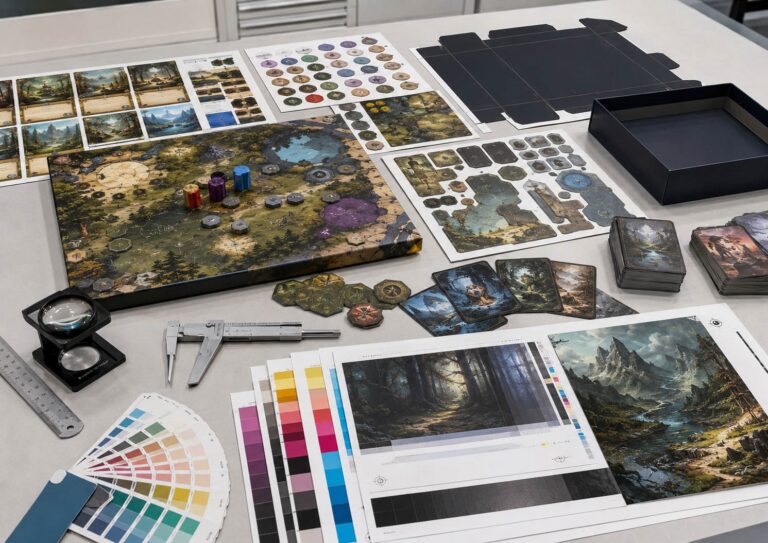
A digitally printed factory sample should not be treated as final offset color approval. Dark backgrounds, rich black, matte lamination, and large flat color areas can shift again when the project moves into mass production printing.
So the sample can confirm structure, material direction, size, finish, packing logic, and handling feel.
It cannot fully guarantee final offset color or batch-to-batch production consistency.
That is not a defect. It is the limit of the sample method.
50–200 Copies Are Usually a Small Production Batch, Not a Prototype
This is where many designers get surprised.
They ask for 50, 100, or 200 copies and still call it a prototype order.
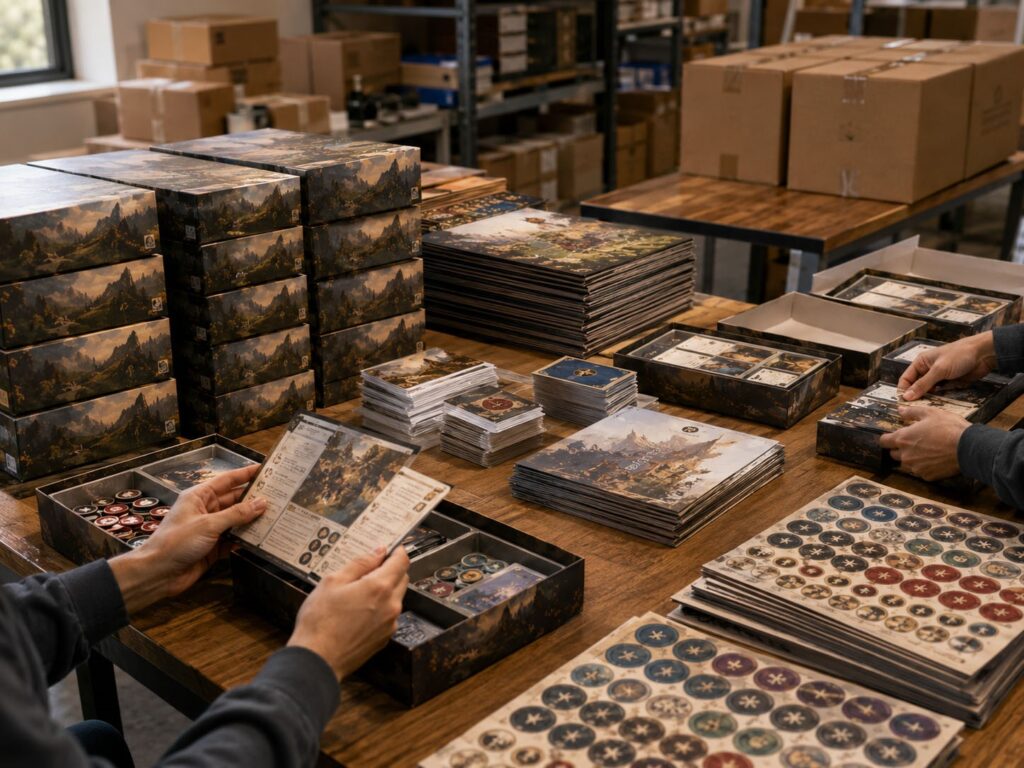
From a factory side, that is usually not a prototype anymore. It is a small production batch.
The quantity is small, but many setup steps remain real: file checking, dieline setup, plate-making or digital setup, die-cutting tools, board mounting, box wrapping, punchboard production, surface finishing, hand assembly, QC, carton packing, export packing, and shipping documentation.
Some steps can be simplified.
Some cannot.
If your game is only a card deck with a simple tuck box, 100 copies may be manageable. If your game includes a mounted board, rigid box, punchboards, rulebook, insert tray, wooden pieces, and multiple card decks, then 100 copies do not behave like a cheap sample.
They behave like a small version of a retail product.
That is why the cost per unit can look uncomfortable.
The factory is not only charging for paper and ink. The factory is spreading setup time, machine changeover, cutting tools, handwork, packing, and coordination across a very small quantity.
This is also why a 100-copy quote may feel “too expensive” compared with 1,000 copies. The material difference is not the main issue. The fixed work is the issue.
For 50–200 copies, the practical question is not:
“Can you make it cheaper?”
The better question is:
“What can we remove or simplify before the cost model locks?”
This is where budget lock-in happens.
Once the box size, board fold, card count, punchboard quantity, and insert direction are locked, most of the cost structure is already decided.
For many custom board games, 500 or 1,000 copies is where the manufacturing discussion starts to behave more normally. That does not make the project cheap. It only gives the setup cost enough units to spread across.
A 100-copy batch can be useful for Kickstarter preview copies, reviewer copies, convention stock, or a limited pilot batch.
It is not a low-cost replacement for POD.
The Practical Decision Order
If you are not sure where your project belongs, use this decision order.
The wrong move is trying to make one stage do another stage’s job.
A home PNP cannot prove retail quality.
A POD prototype cannot always prove factory structure.
A digital sample cannot fully approve offset color.
A PPS should not be used for design exploration.
If the game has a full retail structure, a 100-copy run does not behave like a cheap prototype.
Don’t use a 1,000-copy production run to fix an unfinished design.
That last point is important.
Some creators move toward mass production because the unit price finally looks better. But a lower unit price does not fix an unstable game. It only gives you more copies of the wrong version.
What to Send a Manufacturer Before Asking for a Prototype Quote
If you contact a board game manufacturer and only say, “I need a prototype,” the factory still does not know what you need.
Quantity alone is not enough either.
A 5-copy publisher pitch and a 5-copy production reference can require different sample routes. A 100-copy convention batch and a 100-copy casual prototype are also not the same job.
Before asking for a quote, send enough information for the manufacturer to decide which production route the project belongs to. At this stage, a rough but honest description is more useful than an incomplete “final spec.”
If your artwork was created or assisted by AI tools, do not send only flattened images and assume they are production-ready. We cover the print-file side in AI Art in Board Game Prototypes: What Factories Actually Need From Your Files.
The most important detail is the purpose.
If the purpose is rule testing, we should not overbuild the sample.
If the purpose is photography, appearance matters more.
If the purpose is production approval, the structure must be close to final.
If the purpose is 100 finished copies, then the project has entered small-batch manufacturing logic.
This is also where a factory should be honest.
If you only need one rough copy to test rules tomorrow, a home PNP or POD service may be more suitable than a factory sample. A manufacturer should not pretend every early prototype belongs in a factory workflow.
But if you need custom cards, mounted game boards, punchboards, rigid boxes, rulebooks, inserts, wooden parts, or a small production batch that reflects the later product, then a factory sample becomes more useful.
The right sample should answer production questions, not only look nice on a table.
Can the board fold into the box?
Can the deck height fit without crushing the rulebook?
Will the punchboards release cleanly?
Does the insert make packing easier, or only make the quote higher?
Is the box size chosen because the components require it, or because the render looked good?
These are not exciting questions, but they decide whether the product can be manufactured without surprises.
Funway Board Game Prototype Risk Pre-Check
Before you ask for a prototype quote, use this quick check. If several answers are still unclear, the project may not be ready for a paid factory sample yet.
If too many of these points are still moving, do not start by asking for the cheapest sample price. Start by reducing the uncertainty first.
One Warning Before You Choose the Prototype Route
Do not start by asking for the “best prototype price.”
Start by deciding what the prototype must prove.
If it must prove rules, keep it cheap and disposable.
If it must prove presentation, use a cleaner prototype but avoid overbuilding.
If it must prove manufacturing, the structure should already be close to final.
If it must be sold or sent as a Kickstarter preview copy, treat it as a small production batch and budget accordingly.
This article does not apply well to games that are still changing every few days. Those projects should not be forced into a factory workflow yet.
It also does not apply cleanly to games with frequent SKU changes, many localized versions, or component systems that are not locked. Those projects need a separate cost model. We will not pretend the same advice covers everything.
For most independent creators, the mistake is predictable:
They look for a Print & Play replacement before locking the prototype purpose.
That order is backwards.
Lock the purpose first.
Then choose the prototype route.
Only after that should you ask who can make it.
If you plan to make a board game prototype, preview copy or small batch production, please first send us your component list and target quantity. We can help you decide whether the project should remain a simple prototype, progress to a factory digital sample, advance to a pre-production sample or be quoted for a small-batch production run.
For 50–200 finished copies, we will usually review the project as a small production batch, not as a low-cost POD prototype. That is the more honest starting point.
Read the Full 2026 Prototype Problem Series
This article is part of our series: Board Game Prototyping Problems Creators Face in 2026.
The series covers the main problems independent creators meet before mass production: