
Custom Board Game Pricing Guide
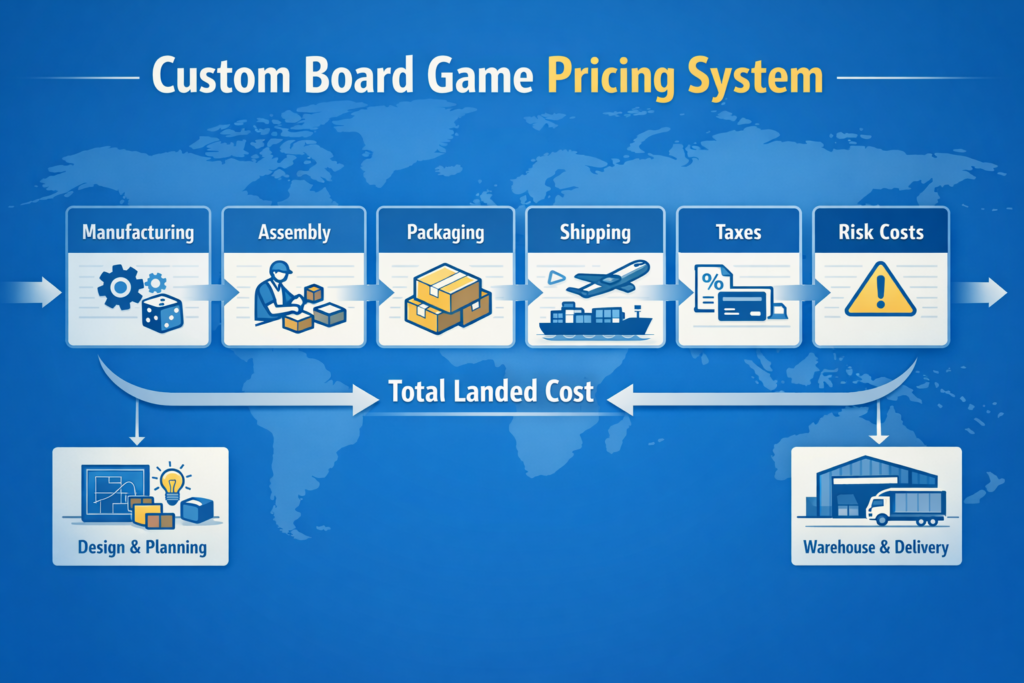
Manufacturing Cost, Shipping, Taxes, and Total Landed Price Explained
In custom board game manufacturing, pricing decisions are rarely driven by a single number. What appears as a simple factory quote often represents only a fraction of the total cost exposure.
Custom board game pricing ≠ factory quote.
A commercially viable project must account for how design choices translate into manufacturing effort, packaging efficiency, freight allocation, and tax treatment across the supply chain.
Final landed cost = Manufacturing + Assembly + Packaging + Shipping + Taxes + Risk Costs This guide serves as a global pricing map, outlining where costs originate and how they accumulate from design stage to warehouse delivery.
It is not intended to calculate a final price. Its purpose is to help publishers and product teams identify cost drivers early—before specifications, packaging, and logistics assumptions become locked and difficult to reverse.
This article is part of the Custom Board Game Pricing System:
• Pricing Structure Overview (This Article)
• Landed Cost Calculation (Article #2)
• Manufacturing Cost Logic (Article #3)
I. What Goes Into a Custom Board Game Price
1. Manufacturing Costs (Components)
Manufacturing cost is determined by the complexity and variety of components, including:
- Printed components (box, boards, cards, rulebooks)
- Molded components (miniatures, inserts, plastic parts)
- Accessories (dice, meeples, tokens, coins)
Key variables include material specifications, tooling requirements, surface finishing, and order volume. This is typically the only cost category shown in an initial factory quote.
2. Assembly & Labor
Board games are labor-intensive products.
- Kitting and component placement
- Manual inspection and correction
- Protective wrapping before packing
Assembly cost scales with component count, variability, and packing tolerance.
3. Packaging & Master Cartons
Packaging decisions affect cost far beyond appearance.
- Carton grade and strength
- Units per carton
- Carton dimensions and stacking logic
Packaging efficiency directly influences shipping cost allocation later in the process.
4. Shipping & Volumetric Weight
Most board games are charged based on volumetric weight (dimensional weight) or cubic volume (CBM), rather than actual gross weight.
As a result, shipping cost is primarily driven by space efficiency, not by how heavy a game feels in hand.
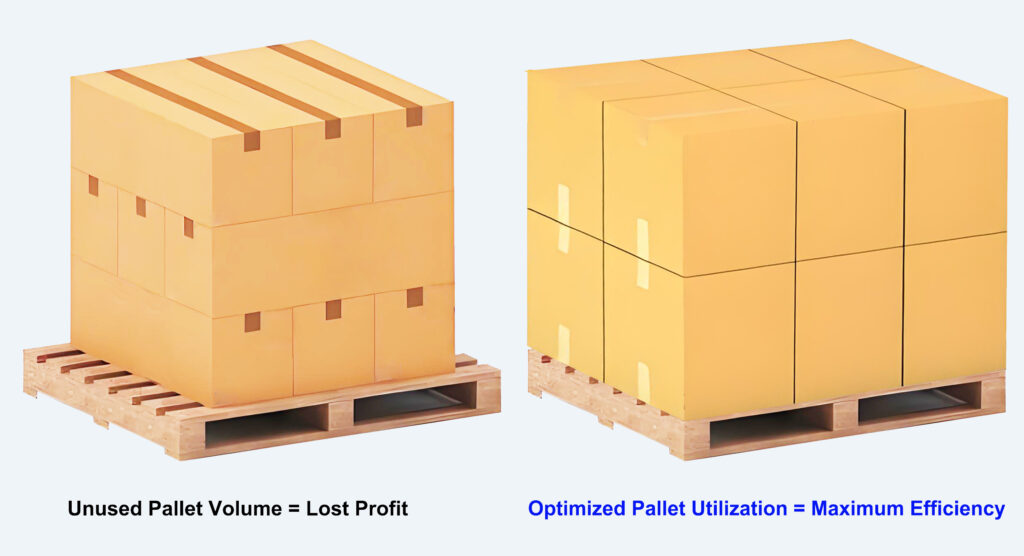
For board games, carton layout and packing density determine pallet utilization, which directly affects freight allocation per unit. Inefficient carton dimensions reduce usable pallet volume and increase shipping cost exposure—particularly in small and mid-volume production runs.
Because packaging structure defines carton efficiency, shipping cost is often locked in long before logistics booking begins. Changes to box size, insert design, or carton configuration at later stages frequently trigger freight reclassification and unexpected cost escalation.
For this reason, shipping should be treated as a design-stage constraint, not a post-production logistics variable.
Detailed volumetric weight calculations, carton efficiency examples, and landed cost scenarios are explained in Article #2:
“How to Calculate the True Landed Cost of a Custom Board Game.”
5. Import Duties & VAT
Taxes depend on:
- HS code classification
- Declared value
- Destination country
VAT and duties are often calculated on goods value plus freight, not manufacturing cost alone.
6. Destination Handling & Local Fees
Final delivery costs may include:
- Port and terminal handling charges
- Customs clearance fees
- Last-mile transport to fulfillment centers
These costs vary significantly by destination and logistics model.
II. From Factory Quote to Total Landed Cost
Custom board game landed cost refers to the total expense incurred from the factory production line to your warehouse door, including manufacturing, logistics, and destination charges. First-time publishers often underestimate landed cost because factory pricing appears to represent the “core cost,” while logistics and taxes are treated as secondary items.
In practice, shipping, duties, and handling can materially change the final unit cost.
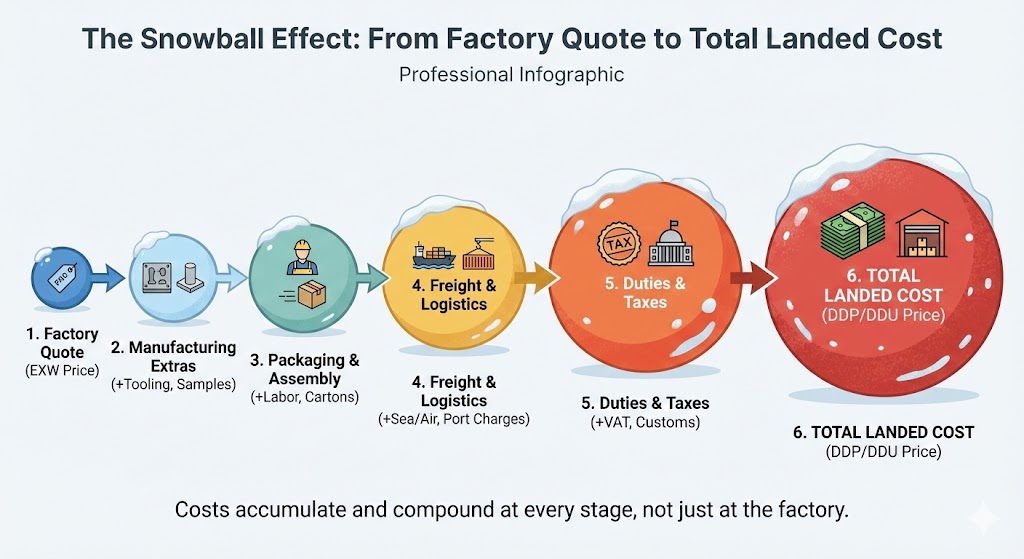
Step-by-step landed cost formulas and scenarios are covered in Article #2.
III. Why Custom Board Games Cost More Than Expected
Board game manufacturing is not simply printing—it is closer to precision assembly at scale. Common misconceptions include:
- “Printing more cards adds minimal cost”
- “Smaller boxes always ship cheaper”
- “More models automatically reduce unit price”
- “Surface finishing is optional”
- “Packaging can be finalized later”
Each of these assumptions breaks down when manufacturing constraints are applied
A full cost-logic breakdown is explained in Article #3:
“Why Custom Board Game Manufacturing Costs More Than You Expect.”
IV. Small Batch vs. Volume Production
Economies of scale in board game manufacturing are non-linear. Increasing order volume does not reduce all cost categories evenly or proportionally.
Some costs amortize with volume, such as tooling, setup, and certain unit-level processing steps.
Others tied to material selection, assembly complexity, packaging structure, and logistics handling remain relatively fixed regardless of run size.
As a result, small and mid-size production runs often carry a higher per-unit cost burden until practical scale thresholds are reached.
Detailed comparisons, breakpoints, and volume inflection logic are covered in Article #3.
V. How to Avoid Pricing Surprises
Before requesting a quotation, confirm the following:
- Are all components and quantities finalized?
- Is the box size and carton structure locked?
- Are destination countries clearly defined?
- Have logistics and tax assumptions been validated?
Clear answers to these questions allow manufacturers to provide stable, realistic pricing, rather than optimistic estimates.
Conclusion: Pricing Is a System, Not a Numbe
Custom board game pricing is the result of interconnected manufacturing and logistics decisions, not a single line item.
Without understanding board game manufacturing cost and landed cost structure, quotes cannot be meaningfully compared.
Understanding the system allows creators to evaluate quotes accurately, plan budgets responsibly, and avoid late-stage cost escalation.
Use the Funway Pricing Risk Checklist as an internal audit tool to validate specifications, packaging assumptions, and logistics constraints before committing to production.
Our engineering team uses this exact framework to lock in your landed costs.
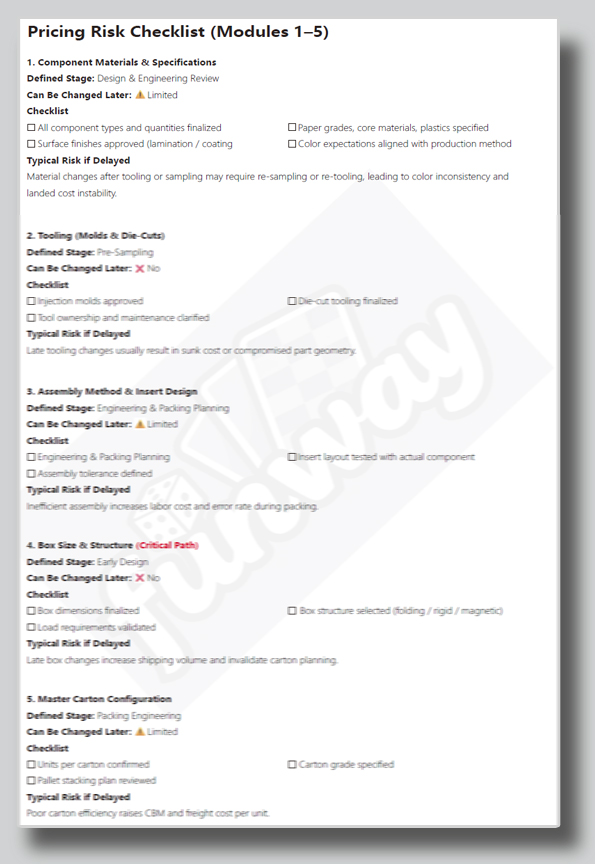
Free Resource: Board Game Pricing Risk Checklist
Don’t leave your budget to chance. Download our comprehensive risk reference table to identify hidden cost drivers before you request a quote.

Start a custom manufacturing inquiry